
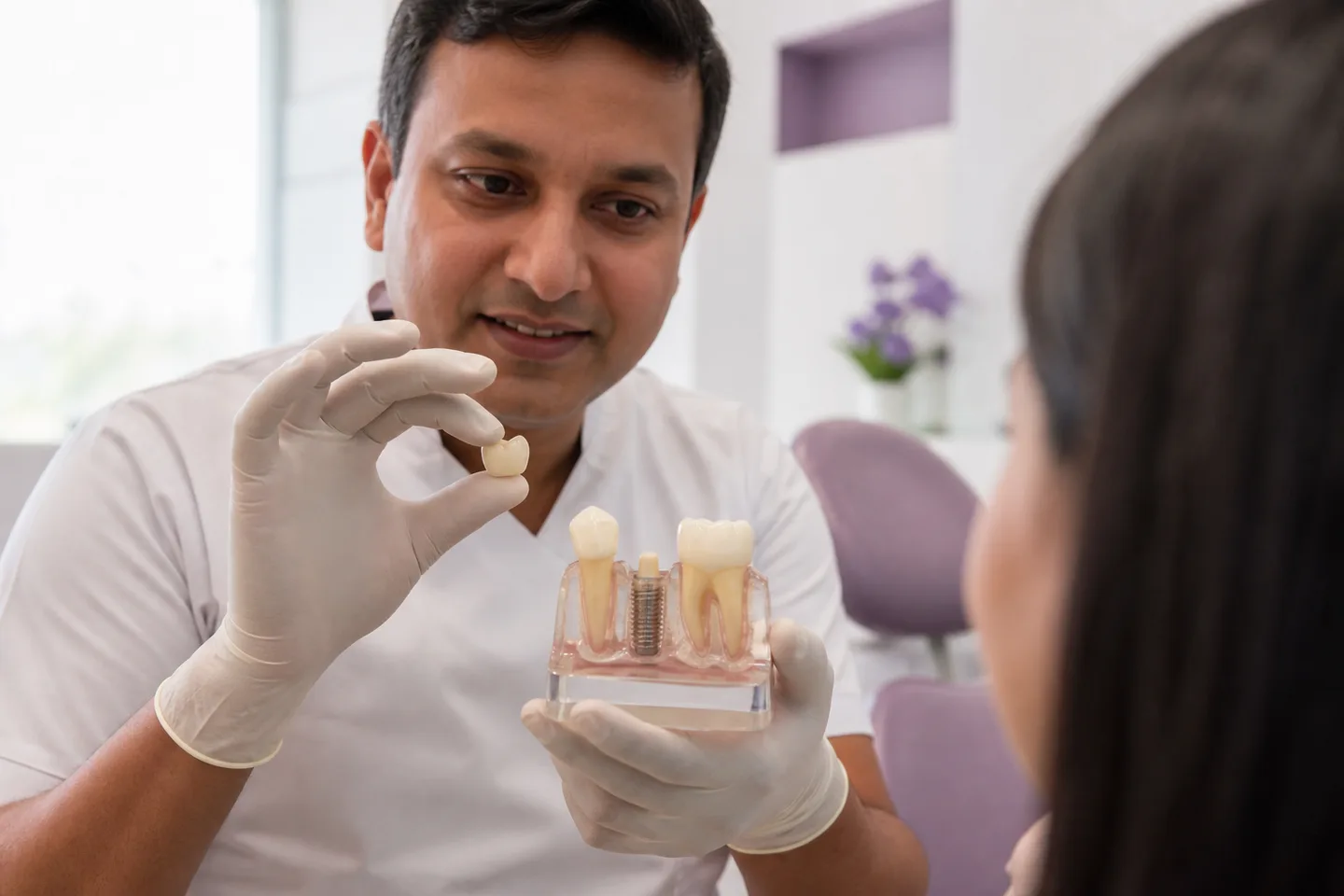
Dental Crowns — what it actually is
A crown is a cap that covers a tooth completely, restoring its shape and taking the chewing load off structure that can no longer carry it. It is what goes over a root-treated tooth, a heavily filled tooth, or a tooth that has fractured.
The material is a real decision, not an upsell. Zirconia is stronger and has no metal margin to show as a grey line at the gum; metal-ceramic costs less and is thoroughly proven. For a front tooth the difference is visible; for an out-of-sight molar it matters far less. Dr Pooja will explain the trade-off rather than simply recommending the most expensive option.
Signs you may need it
One of these on its own is worth a look. Two or more, and it is worth booking rather than waiting to see whether it settles.
- A tooth that has had root canal treatment
- A large old filling with a crack running through it
- A tooth that has fractured or broken a cusp
- A crown that has come loose, or whose margin has darkened
- Discomfort on release when you bite on a particular tooth — often a crack
- A tooth so heavily filled that there is more filling than tooth
How it is done here
At the first visit the tooth is prepared under local anaesthetic, an impression is taken, and a temporary crown is fitted so you leave with a normal-looking tooth. The permanent crown is made in the laboratory over about a week, then tried in, checked against your bite and against the shade of the neighbouring teeth, and cemented. If the shade is not right at the try-in, it goes back to the laboratory — it is not cemented and hoped for.
What to expect, step by step
These are genuinely sequential — each step depends on the one before it, which is why some treatments cannot be finished in a single visit.
- 01
Preparation
The tooth is shaped to make room for the crown. Local anaesthetic throughout.
- 02
Impression and shade
A precise impression, and the shade matched against your own teeth in daylight.
- 03
Temporary crown
Fitted the same day so the tooth is protected and you look normal in the meantime.
- 04
Laboratory
The crown is made to fit your bite. Usually about a week.
- 05
Fit and cement
Tried in, adjusted for bite and contact, then permanently cemented.
Questions patients ask about crowns
How long does a crown last?
Ten to fifteen years is typical, and many last considerably longer. What ends a crown is usually decay at its margin or gum disease around it, rather than the crown itself failing — so it lasts as long as the tooth underneath is looked after.
Zirconia or metal-ceramic — which should I choose?
Zirconia is stronger, needs less tooth removal in some designs, and has no metal margin that can show as a grey line at the gum. Metal-ceramic costs less and is well proven. For a visible front tooth the aesthetic difference is real; for a molar nobody sees, it is much less important.
Will the crown look like my other teeth?
The shade is matched against your own teeth before the crown is made, and checked again before it is cemented. If it is wrong at the try-in stage it goes back to the laboratory — that is exactly what the try-in is for.
Does having a crown hurt?
The tooth is numb for the preparation, so no. The temporary crown can feel slightly different for a few days, and some sensitivity to cold in that period is normal.
My crown has come off. What do I do?
Keep it, do not try to glue it back yourself, and call the clinic. If the crown and the tooth underneath are both sound it can often simply be re-cemented. Do not leave the prepared tooth uncovered for weeks — it is sensitive and it can move.